

Muscle isn’t about looking “fit.” It’s about staying alive, staying sharp, staying powerful — in your bones, in your brain, in your future.1–3
Women are told to get smaller. Biology says the opposite: Your muscle is the most protective, life-giving tissue you have.1–4
And losing it?
Not an option — not if you want to feel strong, stable, energetic, and hormonally supported.2–4
Muscle Is Medicine: Why Women Can’t Afford to Lose It
January 2, 2026
Muscle Is Medicine: Why Women Can’t Afford to Lose It
January 2, 2026
1. Muscle is your body’s internal pharmacy
When women build muscle, everything gets better. Muscle stabilizes your hormones. Muscle supports your bones. Muscle keeps your metabolism from crashing.1–4
Muscle even talks to your brain — literally — through tiny chemical messengers called myokines that help with mood, energy, and clarity.1,5
There’s a reason Dr. Stu Phillips, PhD, says:
Muscle even talks to your brain — literally — through tiny chemical messengers called myokines that help with mood, energy, and clarity.1,5
There’s a reason Dr. Stu Phillips, PhD, says:
“Maintaining muscle mass is absolutely critical as we age. It’s one of the most important things you can do for long-term health.” (Interview, Science Focus Magazine, 2021)
2. Women lose muscle faster and earlier than men
Around your mid-30s, your muscle naturally begins to decline.2,3 Add stress, dieting, sitting all day, birth control, hormonal shifts… and the pace speeds up.
This matters because:
• Less muscle = weaker bones3,4,6 • Less muscle = slower metabolism3,7 • Less muscle = lower energy2–4 • Less muscle = more injuries2–4,6 • Less muscle = worse aging2–4
As Dr. Gabrielle Lyon, Functional Medicine Physician, puts it:
This matters because:
• Less muscle = weaker bones3,4,6 • Less muscle = slower metabolism3,7 • Less muscle = lower energy2–4 • Less muscle = more injuries2–4,6 • Less muscle = worse aging2–4
As Dr. Gabrielle Lyon, Functional Medicine Physician, puts it:
Muscle is the organ of longevity. It determines how we age, how we resist disease, and how strong we stay. (Lyon, 2019)
Read that again.
Your muscles tell your bones to stay dense.4,6
No muscle = no signal.
Your muscles tell your bones to stay dense.4,6
No muscle = no signal.
3. Muscle is the female superpower no one teaches us about
Growing up, girls are taught to be thin. Boys are taught to be strong.
But strong women live longer.2–4,8
• Strong women metabolize better.3,7,8 • Strong women fall less, break less, age slower.2–4,6,8 • Strong women think clearer.1,5 • Strong women feel better inside their bodies.1–4
This isn’t hustle culture. This is biology.
But strong women live longer.2–4,8
• Strong women metabolize better.3,7,8 • Strong women fall less, break less, age slower.2–4,6,8 • Strong women think clearer.1,5 • Strong women feel better inside their bodies.1–4
This isn’t hustle culture. This is biology.
4. You don’t need to become a “gym girl” — you just need to lift something
Two to three strength sessions a week. It can be dumbbells.
It can be resistance bands. It can be your own body weight.
Consistency beats intensity. You’re not building muscle to look a certain way — you’re building muscle to stay here.
To stay vibrant. To stay powerful in a world that profits from your weakness.4,6,9
It can be resistance bands. It can be your own body weight.
Consistency beats intensity. You’re not building muscle to look a certain way — you’re building muscle to stay here.
To stay vibrant. To stay powerful in a world that profits from your weakness.4,6,9
5. And yes — nutrition matters (this is where creatine enters quietly)
Your muscle is made of protein. Your energy system is fueled by things like creatine.10
Your bones need load + nutrients. You don’t have to overhaul your diet — just support the thing that supports you.
A little more protein.
A little more lifting.
A little less fear of taking up space.
Muscle responds to intention.2–4,8
Your bones need load + nutrients. You don’t have to overhaul your diet — just support the thing that supports you.
A little more protein.
A little more lifting.
A little less fear of taking up space.
Muscle responds to intention.2–4,8
6. Muscle is the most feminine thing you can build
Let the world fear female strength.
Why?
Because muscle is medicine.1–4,8
It keeps you grounded.
It keeps you upright.
It keeps you powerful in every season of womanhood.
And that’s what makes a woman unstoppable.
Why?
Because muscle is medicine.1–4,8
It keeps you grounded.
It keeps you upright.
It keeps you powerful in every season of womanhood.
And that’s what makes a woman unstoppable.
7. So Where Does Creatine Fit Into All This?
If muscle is medicine, creatine is the molecule that helps that medicine work.
Creatine isn’t about getting bulky.
It isn’t about gym culture.
It isn’t a trend, or a “fitness supplement,” or something reserved for athletes.
Creatine is cellular energy.
It is the backbone of how your muscles contract, how your brain thinks, how your bones stay stimulated, how your cells recover, and how your body ages.10
Women, on average, store less creatine than men.6–7
Women consume less creatine from food.3
And female hormones — estrogen, progesterone — change how creatine is used inside your cells across your entire lifespan.10
Which means this:
When women supplement creatine, the benefits are deeper, broader, and more essential than most people realize.
Creatine supports:
• muscle strength and maintenance • bone-loading capacity (muscle contraction sends the signal bones need)4,6 • cognitive function and clarity5 • mood resilience5 • metabolic stability7 • healthy aging and physical independence8 • recovery, energy, and performance10
Creatine isn’t for bodybuilders.
Creatine is for women who
Creatine isn’t about getting bulky.
It isn’t about gym culture.
It isn’t a trend, or a “fitness supplement,” or something reserved for athletes.
Creatine is cellular energy.
It is the backbone of how your muscles contract, how your brain thinks, how your bones stay stimulated, how your cells recover, and how your body ages.10
Women, on average, store less creatine than men.6–7
Women consume less creatine from food.3
And female hormones — estrogen, progesterone — change how creatine is used inside your cells across your entire lifespan.10
Which means this:
When women supplement creatine, the benefits are deeper, broader, and more essential than most people realize.
Creatine supports:
• muscle strength and maintenance • bone-loading capacity (muscle contraction sends the signal bones need)4,6 • cognitive function and clarity5 • mood resilience5 • metabolic stability7 • healthy aging and physical independence8 • recovery, energy, and performance10
Creatine isn’t for bodybuilders.
Creatine is for women who
References
Pedersen BK, Febbraio MA. Muscles, exercise and obesity: skeletal muscle as a secretory organ. Nat Rev Endocrinol. 2012;8(8):457–465.
Cruz-Jentoft AJ, Bahat G, Bauer J, et al. Sarcopenia: revised European consensus on definition and diagnosis. Age Ageing. 2019;48(1):16–31.
Beaudart C, Zaaria M, Pasleau F, Reginster JY, Bruyère O. Health outcomes of sarcopenia: a systematic review and meta-analysis. PLoS One. 2017;12(1):e0169548.
Zhao R, Zhang M, Zhang Q. The effect of different types of exercise on bone mineral density in postmenopausal women: a systematic review and meta-analysis. J Orthop Sports Phys Ther. 2017;47(4):241–251.
Sirago G, Conte E, Frigeri A, Amadio P, Massai L. Myokines, brain and neurodegenerative diseases: the beginning of a new chapter. Int J Mol Sci. 2023;24(3):2629.
Kitase Y, Vallejo JA, Gutheil W, et al. Bone cell-derived chemokine CCL7 mediates the bone–muscle crosstalk during exercise. Curr Osteoporos Rep. 2018;16(5):675–683.
Wolfe RR. The underappreciated role of muscle in health and disease. Am J Clin Nutr. 2006;84(3):475–482.
Landi F, Calvani R, Cesari M, et al. Sarcopenia: an overview on current definitions, diagnosis and treatment. Curr Protein Pept Sci. 2018;19(7):633–638.
World Health Organization. Physical activity. WHO website. Updated 2025. Accessed December 8, 2025. Muscle-strengthening activities should be done involving major muscle groups on 2 or more days a week.
Kreider RB, Kalman DS, Antonio J, et al. International Society of Sports Nutrition position stand: safety and efficacy of creatine supplementation in exercise, sport, and medicine. J Int Soc Sports Nutr. 2017;14:18.
4.8
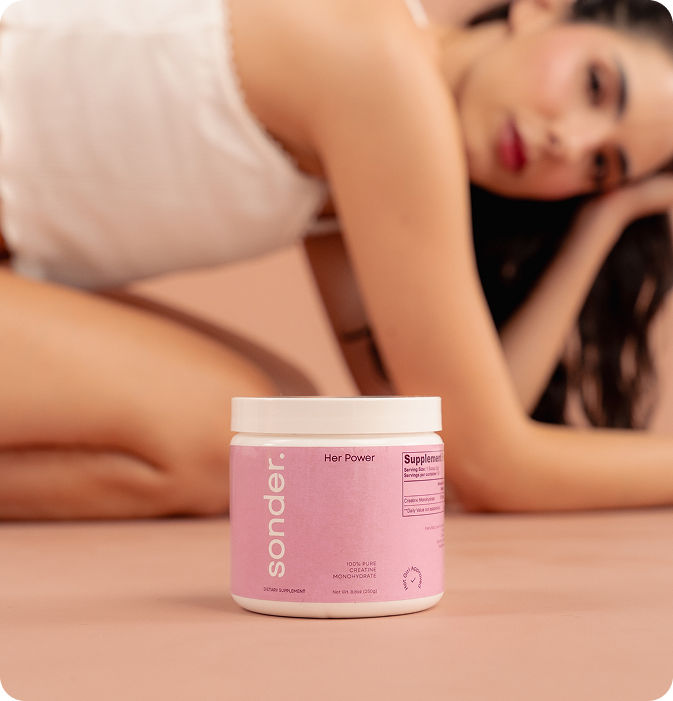
Her Power Creatine gives your muscles the energy they need to grow, repair, and protect you. It works where your strength begins—inside your cells
Shop Now
4.8
Her Power Creatine gives your muscles the energy they need to grow, repair, and protect you. It works where your strength begins—inside your cells
Shop Now


Previous Article


Next Article